
Cobwebb AI
Transform Unstructured Documents into Actionable Data with AI-Powered Automation
What is a Domain-Specific Large Language Model (DS-LLM)?
In simple terms, a DS-LLM is an AI that has been specialised to understand and speak the “insider language” of a particular industry or field.
While general-purpose models (such as ChatGPT, Gemini) are “jacks-of-all-trades,” domain-specific models are the specialists. They trade broad, surface-level knowledge about everything for deep, nuanced expertise in one area.
Why General Models Aren’t Always Enough
General models are trained on the open internet (Wikipedia, Reddit, news). This makes them great at writing poems or explaining general physics, but they often struggle with:
- Jargon: Using technical terms incorrectly or missing subtle context.
- Hallucination: Confidently making up facts in high-stakes fields like medicine or law.
- Privacy: General models may not meet the strict data-handling requirements of specific industries.
Generic AI can be a liability for an enterprise; a domain-specific LLM (such as Cobwebb AI) is an asset. While your competitors are struggling with ‘hallucinations’ and data leaks using public models, Cobwebb AI learns from your proprietary data and industry-specific logic. Using machine learning embedded within Cobwebb AI, we turn your internal knowledge and unstructured data —thousands of documents, contracts, and case files—into a secure, high-precision engine that can help automate complex workflows while adhering to strict data security and compliance regulations.
Benefits
- Converts unstructured documents into usable data
- Much higher data-extraction accuracy
- Access to powerful pre-built or custom AI models
- Scales easily with your business
- Continuous improvement over time
- Integrates with existing automation workflows
- Cloud hosted for rapid deployment
- Data is secured and isolated. Conforms to ISO/IEC 27001, 27017, 27018, and SOC 2/3
Why have DS-LLM?
Efficiency: They are often smaller, faster, and more cost-effective because they don’t need broad general knowledge (like cooking or celebrity trivia).
Safety: Reduced risk of off-topic, irrelevant, or inappropriate generations due to narrower, domain-focused training.
Enhanced Accuracy: By leveraging structured approaches to unstructured data and domain-specific tuning, DS LLMs deliver more consistent and trustworthy results.
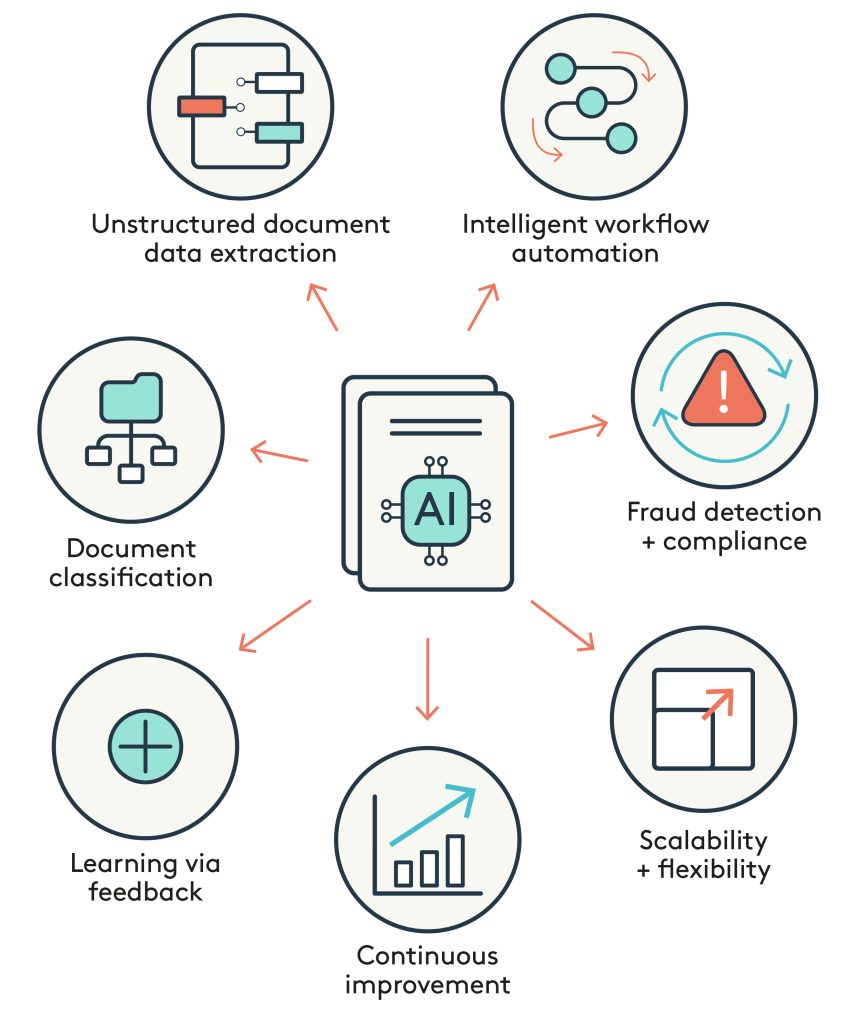
Scalability & Flexibility: These models can be scaled across teams and processes while remaining adaptable to changing document types, workflows, and regulatory needs.
Continuous Improvement: Systems can learn from corrections, feedback loops, and new data, steadily improving performance and business outcomes over time.
Key Capabilities Around AI-Driven Document Processing
Unstructured Document Data Extraction: Convert complex, unstructured documents into usable, structured data for downstream systems.
Document Classification: Automatically categorise documents for routing, processing, and analysis (ensuring the right action is taken at the right time).
Intelligent Workflow Automation: Trigger and manage end-to-end processes based on document content, reducing manual intervention and operational delays.
Fraud Detection and Compliance: Identify anomalies, flag suspicious patterns, and ensure regulatory compliance across documentation and transactions.
Why Cobwebb AI?
If you want creativity, use a general model. If you want reliable automation that understands your business context, you want a domain-specific model like Cobwebb AI.
If you’d like to learn more about the work that Cobwebb is doing with DS-LLM’s or explore how they can address your organisation’s specific document challenges, contact us to find out more.